Thursday, 16 February 2017

Weekend in Amsterdam Chapter Three


  After breakfast we packed our suitcases and headed for the railway station. Opened to the public in 1889, Amsterdam centraal station was built to impress. It was a beautiful building of brick and stone construction, with a number of Dutch gables and towers along its facade.

“Look at this,” I said to Godfrey, as I read from an information sheet in the stations foyer.
“The station is mounted on three man-made islands, and resting on over 8,000 wooden piles driven deep into the mud.”
I thought it a fascinating fact, but Godfrey remained unimpressed. We drank a strong coffee in the station cafe, with which he was impressed, and enjoyed a tasty Danish pastry while awaiting the arrival of the train to Eindhoven. The train arrived on time, something unheard of in my hometown, where trains were often overdue, with no apology or attempt to improve the service.
Godfrey suggested that we share a first class carriage, even though my junior staff status dictated otherwise. I would have welcomed the solitude, as I had no idea what topics of conversation to discuss with Godfrey, and I was nursing a hangover from the night before. I pointed out that my ticket didn’t state first class, but Godfrey reassured me that if the inspector challenged us, he’d pay the difference in fares from our travelling expenses.
“Which film did you see last night,” I asked?
“I decided not to go.” he answered. “I studied today’s itinerary and then I went to bed early.”
Soon after settling into the carriage, two men entered and stored their luggage on the rack. I recognised one of them as a foreman at the factory where Godfrey and I worked, although the other man I had no recollection of ever having seen before.
They said, “Good morning,” before realising, through conversation, that we all worked at the same Blakewater factory, although visiting different locations.
“Are you senior staff?” asked the tool-room foreman, fiercely conscious of his newly acquired senior staff status.
“Yes,” answered Godfrey, telling no lies.
The tool-room foreman studied me closely, and although I looked the part in my new overcoat, suspicion showed on the foreman’s face as old memories began to form.
“He isn’t,” said the foreman, pointing his stubby index finger directly at me.
“He did some electrical wiring in the tool-room. You don’t belong in first class young man,” he said, glaring at me spitefully, “I’m going to call for the ticket inspector and have you removed unless you leave right now.”
I hated the class system at the factory. There were three separate and very different restaurants, one specifically for senior staff managers and foremen, one for junior staff charge-hands and maintenance staff, of which I was one, and one for the rank and file production workers. The factory also had senior staff toilets which the rest of the workforce weren’t allowed to access, the key to this status symbol being highly prized amongst the privileged few who held that honour.
The mood in the carriage became tense as I glared angrily at the tool-room foreman. Godfrey, who knew from experience what was about to happen next, tried to defuse the situation by explaining our intention to pay the discrepancy in fares, but I was not in an explaining kind of mood.
 “You little shit,” I yelled, “who the hell do you think you are? Get up from your seat and I’ll knock you down again faster than you can fall.”
 “You can’t talk to him like that,” said his travelling companion in disbelief. “He’s a member of senior staff.”
“I don’t give a flying fuck what he is, or you either for that matter,” I roared. “But if he’s not out of this carriage in two seconds flat, he goes out of that window and you along with him.”
The tool-room foreman turned quite white, he was shaking, and all of his bravado had deserted him. He began gathered his belongings, and along with his travelling companion they left in a hurry to look for a carriage with a better class of clientele.
As they were in the process of leaving, a man in a raincoat who appeared to be searching for a carriage, stopped for a moment to watch the fracas, but seeing the way in which I’d ejected other passengers, he decided to move on.
The ticket inspector arrived shortly thereafter. Perhaps it was the foreman’s parting shot, but the inspector had been expected anyway and Godfrey paid the discrepancy in our fares.
I tried to calm down and forget about the incident by looking out of the window in search of windmills. I was amazed when I didn’t see any at all, as I’d been led to believe that The Netherlands was the land of windmills.
As a child, I’d played spot the windmill with my parents when visiting the seaside town of Blackpool, a popular holiday resort, and luckily, for a child like me, on my very own doorstep. My father always declared that the last one to see the windmill, which surprisingly stood on a housing estate, would have to pay for the ice-creams. He, of course, was always the last one to spot it, while I was always allowed to be the first.
 After watching the flat Dutch landscape pass by for over an hour, without spotting a single windmill, I gave up the challenge and drifted off to sleep, only to awake as the train pulled into Eindhoven station.
As we disembarked, I spotted the tool-room foreman, and his travelling companion, at the far end of the platform. Leaving Godfrey to guard the suitcases I chased after them. They panicked as they spotted me bearing down on them, and made a dash for the exit dragging their heavy suitcases, in a futile attempt to escape my wrath. Leaning forward, with my hands on my knees as I attempted to catch my breath, I laughed at their panic stricken retreat, but as they never once looked back, they failed to realise that I never intended to catch them, and that I’d stopped chasing.
As we left the railway station we spotted the tool-room foreman, and his companion, hailing a taxi for their journey to the Eindhoven factory. Godfrey and I were travelling a further eleven kilometres to Valkenswaard, and to save on travelling expenses for more important purchases like beer, we caught the service bus.
 It was colder in the Netherlands than on our departure from England. As we travelled on the bus, I tried to explain to Godfrey that the Gulf Stream keeps England milder in winter than it would otherwise be, whilst Eindhoven, although further south than our home in Lancashire, had no such advantage.
We passed frozen ponds and canals, which were confidently being used for skating. Skating was a risky occupation in England, as the ice was rarely thick enough to support the weight of an adult, or a child, and could never be totally relied upon even on the coldest of winter days.
The driver called out Valkenswaard, and we alighted in the market square. It was a market day, and the town was alive with activity. Some of the stallholders were dressed in national costume, with painted clogs stuffed with newspapers as insulation against the winter cold.
Clogs were still worn by some Lancashire people, but confined to the older generation, traditionalists who’d never worn but clogs since childhood. I’d never worn clogs in my life, as my parents were affluent enough to buy me shoes. Many of my less fortunate classmates had little choice in the matter, as clogs were cheaper to buy and lasted longer when worn on the feet of destructive children.
In The Netherlands they made their clogs entirely from wood, while in Lancashire, although having a wooden sole clad with irons, rather like a horse shoe, the tops were made from stiff leather and laced up like a shoe, or fastened with buttoned straps. Some of the stall holders were selling clogs, or klompen in the Dutch vernacular. They appeared to be made from plain unvarnished wood, or painted red for local use, but stained and varnished with transfers of windmills for tourist consumption.
Many had been converted to become table lamps, with a single clog representing the hull of a barge, while the elliptical lamp shade gave the appearance of a sail. I’d purchased one of these lamps for my mother when as a child I’d visited Middleburg on a school holiday. Although she professed to like it, at its presentation, it had been consigned to a cupboard and never more seen the light of day.
The ground floor, of the hotel Cordial, consisted of a narrow room with a dark oak bar which ran for three quarters of its length. It was filled with knick-knacks, as appeared to be the Dutch tradition, with foreign coins glued to the bar top, while banknotes, from around the world, jostled for position with photographs of residents and visitors alike around the walls. Adjacent to the bar were circular tables, with a solitary glass ashtray centred on each, along with a quantity of beer mats so that drinkers wouldn’t leave rings on the highly polished table tops. At the rear of the room the tables were no longer circular but square, laid with crisp white table cloths, nickel silver cutlery, and with condiments for use by diners.
 There was no reception desk at which to check in, and except for a group of elderly men who were playing cards and drinking Bols Genever, the room was empty. Among the card players, a man of late middle age wearing a white shirt with dark trousers and a food stained apron, welcomed us.
“Dhr Dale?” he enquired of me as I looked by far the more prosperous of the two in my best blue suit and brand new overcoat.
“I’m Dale,” said Godfrey, a little peeved that he’d been mistaken for the underling, “and this is Mr Evans,” he said, gesturing towards me.
“Dhr Bos,” said the man, patting his chest to indicate that his name was Dhr Bos, or Mr Forest in translation.
“Ah so you’re the boss?” said Godfrey, mistaking his name for his vocational title. The man failed to correct Godfrey’s mistake, as being unable to speak a significant amount of English he was unaware that confusion existed.
 We were hungry, as except for a Danish pastry consumed at the railway station in Amsterdam, we hadn’t eaten since breakfast. Godfrey tried to make Dhr Bos understand, by pointing down his throat and saying food very loudly. Dhr Bos wasn’t in the least bit deaf, but Godfrey, like many British travellers, tended to treat people as if they were, as it takes less effort to shout than to learn a foreign language.
“Yah,” said Dhr Bos, proving the theory that shouting at foreigners really does cross the language barrier.
Dhr Bos disappeared through a door at the far end of the room, which lead into what I assumed must be the kitchen. Almost immediately, a carbon copy of Dhr Bos appeared through the very same door. He was dressed like the man who had exited, but was much younger, as if the door led into some kind of age reversal chamber.
“Dhr Bos,” he announced.
Now Godfrey really was confused, surely they couldn’t both be the boss. Recognising his confusion I whispered into his ear.
“I think this is probably Dhr Bos junior, the son of Dhr   Bos.”
Godfrey turned a bright shade of pink, as he often did when embarrassed, which happened to be every time anyone spoke to him.
“My father will prepare food,” announced Dhr Bos junior. “If you would like to follow me I will show you to your rooms where you may freshen up.”
He escorted me to a room at the top of the stairs, and Godfrey to a similar room three doors along the landing. The bedroom was old fashioned, with a large walnut veneered wardrobe inlaid with tulips and chrysanthemums. It featured two bow fronted drawers beneath mirrored doors, which were used to store extra bedding, and judging by the current temperature of the room I was definitely going to need extra bedding.
The beautiful old wooden bed looked like Santa’s sleigh, with a scroll shaped headboard in highly polished walnut veneer and a footboard to match. It was decorated with the same floral patterns, which must once have been inlaid with highly coloured woods, but which had faded over the years to become almost indistinguishable in colour from each other.
 A cast iron radiator, similar to the ones I remembered from my school days, sat beneath a window which overlooked the market square, while a second window, on an adjacent wall, overlooked the “Eindhovenseweg,” the road on which we’d arrived, and on which we’d return when the time came for our departure.
While looking out of the window, a bus pulled up at the bus stop, and a man in early middle age, wearing a trench coat and trilby hat, got off the bus. It was about half an hour since our arrival in Valkenswaard, and I reasoned that this must be the next bus to arrive from Eindhoven. He looked slightly out of place, because of his style of dress, as did Godfrey and I, a stranger to the town, and the more I watched him the more familiar he began to look to me.
After a little memory searching I was convinced that I’d seen him on our train from Amsterdam. I vaguely remembered him looking into our carriage, as if searching for a place to sit, and on seeing that it was already occupied, he’d quickly moved on.
I’d also noticed him on the station platform, as I rested with my hands on my knees, after chasing the tool room foreman and his friend. Most of the passengers had been startled to see a madman chasing passengers, some had appeared scared and others angry, but this individual was the only person to have remained calm and unruffled, and that had registered in my mind.
He stood at the bus stop for a very long period of time, and appeared to be taking a keen interest in the hotel. I thought that perhaps he was looking for somewhere to stay, him being in a strange town, but I couldn’t understand how he’d managed to miss our bus and had to catch the next one, when we’d arrived on the same train. He stared at the hotel, until he spotted me watching him from my bedroom window. Immediately he looked away, as if embarrassed by my having seen him, and he quickly disappeared from view in the crowded market.
The radiator was stone cold, as was the water in the only tap situated on a triangular washbasin in the corner of the room. I discovered hot water in the one and only bathroom, which was a short walk along the landing, and situated next to Godfrey’s room.
Dhr Bos had prepared coffee, with cream in a small white jug. Cubes of brown and white sugar jostled for position in a cut glass sugar bowl, with nickel silver sugar tongs on top. Ham and cheese, sliced salami, and a very pink and rather rubbery meat, which Godfrey and I failed to identify, were arranged neatly around a huge charger like toppled dominoes. Godfrey pointed to the rubbery meat and asked Dhr Bos for identification, only to be met by a blank stare. Godfrey worked his way around the plate pointing out each item in turn.
“Ham,” suggested Godfrey.
“Yah, ham,” agreed Dhr Bos.
“Cheese,” pointed out Godfrey.
“Kaas,” corrected Dhr Bos, believing that what Godfrey required was a Dutch translation of what was on offer.
 “Salami,” said Godfrey, pointing at the pink circles with flecks in them.
“Yah,” agreed Dhr Bos.
“Meat,” stressed Godfrey pointing at the pink rubber.
 “Paardenvlees,” said Dhr Bos, before leaving us to ponder his explanation.
Having failed to satisfy our curiosity about the origins of what was on offer, but being ravenously hungry, we ate the questionable meat before taking a constitutional around the market square. Three doors away from the hotel we passed a butchers shop with cuts of meat displayed on white ceramic tiles in the shop window. Some of the meat looked rather like the meat we’d just eaten, and I pointed out the shop sign to Godfrey.

Dhr Van der Gaag. de paard slager.


My observation meant nothing to Godfrey until he noticed what I had already seen, a picture of a horse’s head at each end of the sign.
“Paardenvlees,” I told him, “horse meat.”

*  *  *  *

I came down for my evening meal around seven o’clock, after indulging in a hot bath in the bathroom along the landing. Godfrey was already at the bar and talking to a pretty teenage girl who was serving drinks. She’d tied her blonde hair into a short pony tail, and wore a white blouse over a dark skirt, along with an apron around her waist and sensible shoes.
“This is Eloise, Dhr Bos’s daughter,” said Godfrey by way of introduction.
“I prefer to be called Oise,” said the girl, pronouncing it as Weese, while looking at me through the prettiest blue eyes I’d ever seen.
“I prefer to be called Ray,” I told her, while holding out my hand for her to take. She held my hand for longer than was sociably acceptable, until I reluctantly broke contact out of embarrassment, unable to hold her gaze under the relentless scrutiny of those beautiful blue eyes.
Oise showed us to our table, explaining that it would be ours exclusively for the duration of our stay. I noticed that she filled her uniform to perfection. Some may have commented that she filled it a little too well, but I wasn’t one of them.
The evening meal consisted of erwt soep, which turned out to be a pea soup rather like my grandmother used to make, but with pieces of salami sausage used instead of the pig’s trotter which she always favoured.
This was followed by biefstuk, gebakken aardappelen en erwten, which we managed to translate, in advance of its arrival, as probably a steak, which was accompanied by fried potatoes, and garden peas extracted from a tin. Like the homemade soup it was excellent.
“I enjoyed that,” I told Godfrey. “The radiators might be cold, the water in my bedroom certainly is, but if this is the standard of cooking at least we won’t go hungry.”
The final course was aardbei ijs, which after a good deal of wild guesswork remained a mystery until the arrival of strawberry ice-cream. This would have been welcome had it been summertime, but in these bitter winter temperature’s something hot with custard would have been far more appreciated.
After our meal we returned to the bar and to Eloise. It transpired that during the winter months the hotel was quiet, we currently being the only guests, except for an elderly German lady who lived in the hotel on a permanent basis. Oise explained that the family did not live at the hotel, but because of the old lady’s residency, she stayed in a spare bedroom on most nights of the week, perchance the old lady, who was not in the best of health, needed night time assistance.
It soon became obvious that despite having a fiancé in Blakewater, Godfrey was smitten by Oise. He dominated the conversation, boring everyone to distraction with his talk of radio signals, while Oise flashed come and rescue me glances. In fairness I did try to steer the conversation in a different direction on many occasions, but Godfrey always steered it back to the subject that he knew and loved.
At ten-thirty I admitted defeat. Leaving Oise to her fate, I excused myself, on the grounds that it had been a long day, and went to my bedroom to read my novel. The old radiator still wasn’t working, and the room was freezing cold. I wasn’t in the habit of wearing pyjamas, in fact I hadn’t even brought a pair with me, so I raided the bedding drawer for extra blankets, stripped to my shorts and a tee shirt, and put on a sweater for extra warmth.

Propping myself into a sitting position, I began to read. I awoke around midnight to a tapping sound on my bedroom door. My book was open at page one, indicating that I must have fallen asleep instantaneously. I responded to the intrusion feeling a little disorientated. I didn’t bother to dress, reasoning that it must be Godfrey on his way to bed and wanting to discuss work schedules for the following day. Opening the door, only slightly, as I’d no intentions of letting Godfrey into my room at this late hour, I was surprised to discover that it wasn’t Godfrey tapping on my door, but Eloise. Her hair was hanging loose around her shoulders, the apron had disappeared, and she’d unfastened an extra button on her blouse.

Sunday, 12 February 2017

Weekend in Amsterdam Chapter Two


Retracing my steps I passed a couple of cinemas along the way, and wondered which film Godfrey had chosen to watch. The western Shalako was playing at the first one, while the science fiction film Barbarella was playing at another. I’d heard that Jane Fonda did a striptease in the film Barbarella, while Brigitte Bardot, who co-starred in Shalako, was in my opinion the sexiest woman on the planet. I wondered should I go to the cinema, as I wasn’t enjoying myself  in Amsterdam, but I decided against it as I only had a limited amount of time to spend in Amsterdam, and I could go to the cinema anytime.
On the Damrak, and not far from my hotel, I discovered a bar with music and the sound of people’s chatter and laughing coming from within. I attempted to peer through the window, but my view was blocked by a heavy, burgundy coloured curtain, supported on a heavy brass pole. Although I stood on tiptoe in an attempt to peer over the curtain, which was supported half way up the window frame, I failed to see inside, which should have served as a deterrent, but it didn't.
Taking pot luck I entered the bar and found myself in a hallway; there I was greeted by a doorman who spirited away my overcoat for a second time that evening. The bar was laid out like a house, perhaps it had once been so, with a staircase to my right, and a hallway leading to a closed door at its far end. Being directed towards a doorway halfway down the hallway, and to my left, I entered the front room, only to discover that the crowd scene, along with the music, was all taped, and except for the barman, and two bar girls who were hustling  sailors, I discovered the room to be empty.
The girls were employed to boost the bar’s takings, as Greta had done earlier at the nightclub, and could well have been offering the same personal services. I was relieved to discover them to be busy, and although I wanted to leave, I ordered a small pilsner to ensure that I was reunited with my overcoat when I left.
A few minutes later a man entered the bar, and although the barroom was almost empty, he chose to sit on a barstool beside me. He was short in stature, late middle aged, and although his hair had begun to recede at the temples, there were absolutely no signs of grey; in fact it was a rather unnatural shade of auburn, and I speculated that it may be dyed. The man’s face looked crumpled, like an unmade bed, while his waist line had expanded over the years, probably due to too many nights spent drinking in seedy bars.
 He ordered his drink in Dutch, before speaking to me in perfect English.
“You are from England, are you not?”
“Yes I am,” I answered, wondering how this strange little man could possibly have known my nationality.
“I am from Russia. My name is Vladimir.”
“Mine’s Ray,” I answered, and took the proffered hand.
“Do you work in the Netherlands, or are you here for your pleasure?”
“I’m on my way to Eindhoven, for work experience.” I answered.  “I’m only staying in Amsterdam overnight.”
“Pity,” said Vladimir, “it’s such a lovely city. What kind of work do you do?”
“I work for a company making components for television and radio sets,” I told him, while wishing the man would go away and pester someone else.
“Electronics is the future comrade; Russia is very much in need of young men with technological knowledge and new ideas.”
I began to feel uncomfortable in Vladimir’s company, as the cold war was currently at its height. Films and television were awash with spy stories involving Soviet agents, and calling me comrade sent a shiver up my spine.
“Why are you in Amsterdam?” I asked, without really wanting to know the answer to my own question.
Vladimir leaned forward and whispered into my ear as if it were of national importance. “I am chief of security at a Soviet radio station here in Amsterdam.”
I pictured a uniformed security guard at a radio station broadcasting Russian folk songs, with perhaps a little Soviet propaganda thrown in for good measure, but that interpretation could not have been further from the truth.
As he leaned forward the jacket of his brown double breasted suit gaped open, and I caught a fleeting glimpse of a small calibre handgun beneath his left armpit. The fact that he wore a firearm convinced me of his diplomatic immunity, which would not have been necessary had he been a glorified doorman at a radio station broadcasting folk songs.
The sailors left the bar, and the bar girls descended on us like vultures. I was under the impression that I was obligated to buy the girls a drink to avoid conflict with the management, so I chatted to one of the girls in a friendly way, while she nuzzled my neck and nibbled at my ear. Vladimir, in contrast, had no such illusions. He shouted angrily at the girls, who quickly returned to their seats at the opposite end of the bar. I waited for the fallout from the doorman, who appeared from the hallway on hearing the commotion. He stared in our direction, but realising that the Russian was  doing the shouting, he disappeared.
“We are having such a nice talk,” said Vladimir to explain his outburst. “We do not need to be interrupted by two silly girls and their inane chatter.”
I agreed with him out of politeness, although I’d been enjoying the company of the girls far more than that of Vladimir, which I found to be intimidating, although I couldn’t explain why.
“You must be aware that the Soviet Union will eventually annex Western Europe,” Vladimir continued, as if nothing untoward had taken place.
“It is one land mass after all, not some foreign land far across the sea like America. This is where the future of the European countries lies, as part of a unified Soviet Union, making it the most powerful nation on earth. It would stretch from Vladivostok on the pacific coast, to Lisbon on the Atlantic coast. Just image the power of such a nation.
“I think the Americans might have something to say about the Soviet Union annexing Europe,” I told him, feeling a little irritated by the arrogance of this ridiculous little man.
“The Americans will not be interested in risking a nuclear confrontation to protect Europe. The Soviet Union will have overtaken the United States in firepower in less than five years time, and then you will see how much they care about your tiny island.
I felt more than a little patriotic, and pissed off with Vladimir’s observations.
 “The Germans thought they could conquer Europe, but they came unstuck, perhaps the Soviet Union won’t find the annexing of Europe quite as easy as you seem to think.”
“The Germans could easily have conquered Europe, if Hitler had not made the same mistake that Napoleon made over a century earlier,” continued Vladimir confidently.
“What mistake?” I asked, walking straight into Vladimir’s propaganda trap.
“By attacking Russia of course,” answered Vladimir, although he failed to explain that the terrible winter weather, starvation, and poor logistics had been the major factors in Napoleon’s defeat on the Russian front.
“Most of Europe had already surrendered,” he continued, “and your little island would not have been able to resist the might of the German Reich without Russian assistance.”
“We weren’t alone,” I continued, bravely trying to fight my corner even though I was far from an expert on the subject. “We had the Commonwealth countries and the Americans fighting alongside us.”
“And do you think that the Americans would have come to your aid if the Japanese had not bombed Pearl Harbour? Don’t be so naive. Churchill was clever to declare war on Japan, as America would never have declared war on Germany had he not done so. He manoeuvred them into the war.
I couldn’t disagree with his assessment, but I didn’t want the Russian to get the better of me, so remembering what my father had told me I made my case.
“The Americans had already come to our aid. Churchill asked Roosevelt for assistance, he was sympathetic but the American people had no appetite for war, so he came up with the idea of lease-lend. Russia also benefitted from lease-lend. I seriously doubt if your country would have been able to contain the Germans on the Russian front without American armaments.
I think I might have won that round because he changed the subject.
“That argument aside, all western politicians are fools, and will be militarily unprepared when Europe is annexed. Only Enoch Powell has the vision to see the reality of what it to come, but after his rivers of blood speech he is a discredited man, branded a racist, and just like Winston Churchill when he warned of the dangers from Nazi Germany, no one is prepared to take him seriously.”
Vladimir appeared to have a grudging respect for Powell. I was unaware of any concerns he may have had about national security, although I did remember something of his rivers of blood speech.
Powell’s constituents had been expressing their concerns about the number of Afro-Caribbean’s settling in their area. Kenya had announced repatriation of its Asian population, and most, because they held British passports, were expected to settle in Britain. Powell speculated that at the current rate of immigration, Britain would have accepted seven million coloured immigrants by the year two thousand, plus the offspring of a generation. He prophesied that coloured ghettos would inevitably spring up, leaving the white population as a minority in some areas, unless immigration was halted immediately and repatriation begun. After his speech he’d been branded a racist, and Edward Heath, the Tory leader, sacked him from his position as shadow defence minister.
I knew nothing of Powell’s involvement in cold war politics, perhaps he’d made a speech about Soviet expansionism, as a shadow defence secretary it was quite possible  he had, but if such a speech had ever been made I was unaware of it.
Vladimir appeared to be concerned that if Powell became powerful, within a future conservative government, perhaps the next leader of the party, or a future prime minister (2), it could be detrimental to the Soviet Union’s expansionist plans, which were going full steam ahead with the invasion of Czechoslovakia to depose the liberal regime of Alexander Dubcek.
I didn’t like the direction this conversation was taking, and wondered what all this political rhetoric was leading up to. I didn’t have long to wait to find out.
 “We need operatives, friends to help us achieve our aims.”
“Are you talking about me?”
“Yes of course,” answered Vladimir, as if it should have been obvious to me from the very beginning.
“I work in a factory making light bulbs and components for radio and television sets. What possible use could I be to the Soviet Union?”
“You would be surprised how valuable you could be. What is more you would be well rewarded for your services.”
“I would never sell out my country,” I responded patriotically, but Vladimir wasn’t finished.
“If a third world war were to occur between the Americans and the Soviet Union, it would not be fought in either of our countries; Europe would become the battleground, and the prize. Better a peaceful annexing of Europe than its annihilation, don’t you think? You would be helping to save the European people from destruction, not betraying them; they would become Soviet citizens instead of casualties of war. Think carefully about what I have said, we will talk again on the subject soon.”
The bar had filled, unnoticed, while we’d been talking. Two Gypsy women in traditional peasant dress, who looked to be mother and daughter, were pedalling their wares. The older woman was selling roses and telling fortunes, while the younger one sold trinkets from a peddler’s tray held by a leather strap around her neck. She wore a long black skirt, which brushed the floor as she moved, and around her waist she wore a white apron tied with a large bow at the back. Above the skirt she wore a white blouse with puff sleeves, which was heavily embroidered around the neck with flowers, as was the apron and the hem of her skirt.
 She glanced at Vladimir  as if for his approval, but when he didn’t react she turned her attentions towards me.
“Zijn jullie Russisch?” she asked.
“She would like to know if you are Russian,” Vladimir translated.
She must have known who Vladimir was, and it was obvious, from her body language, that she was wary of him, otherwise why would she seek his approval, and then assume that I was Russian.
“English,” I answered, and then as an afterthought I translated. “Engels, one of the few words I’d learned during my short stay.”
“You buy necklace for your sweetheart?” suggested the girl, making my Dutch translation redundant.
She leant forward to display the necklace, lifting the pendant with her fingers and holding it close to my face. At first glance I thought it to be a flying swan cast in a base metal, although on closer examination it turned out to be a winged penis complete with testicles. It took me a considerable amount of time to concentrate on the pendant, as I had a clear view down her blouse as she bent forward. I found myself transfixed by her nipples, which were dark, and even darker than her olive skin.
“I don’t have a sweetheart,” I protested, after regaining my composure.
“You buy one for yourself?” she insisted, unwilling to take no for an answer.
“No thank you.”
She glanced at Vladimir, and when he showed not the slightest interest in the transaction she continued with her sales pitch.
“Fucking scissors?” she announced, which took me very much by surprise, as I was unused to hearing a woman swear.
She produced a pair of painted wooden scissors from her tray; they were about ten inches long, with a naked woman, sporting huge breasts, attached to one of the blades, while a naked man with an enormous erect penis, almost as big as himself, was attached to the other. As she squeezed the handles the two naked bodies came together, and the huge penis disappeared from view, before reappearing as she operated the scissor action. I politely declined her offer, and she moved away muttering and cursing under her breath.
I looked at my watch; it was after eleven. “I think I’ll call it a night and go back to my hotel,” I announced, still feeling uncomfortable in the presence of Vladimir. “I have to catch a train in the morning.”
“You don’t really want to stay at a hotel?” said Vladimir, phrasing his comment more like an instruction than a question, before adding, “so impersonal, don’t you think? Why don’t you stay at my home? I have a nice big bed, big enough for the two of us, and I can cook us breakfast in the morning.”
Suddenly the penny dropped, a man twice my age with dyed hair, who becomes annoyed because his companion is receiving attention from a bar girl. He wasn’t annoyed because she was hustling drinks; he was annoyed because she was flirting and he was jealous.
“I think you’re barking up the wrong tree,” I told him. “In fact you aren’t even in the right forest.”
 “I am so sorry if I misinterpreted the signals,” apologised Vladimir.
 I didn’t know what signals I was sending out, I didn’t even know that I was sending out signals, but whatever I was doing, if this was the consequence, I must remember to stop doing it.
“I hope you are not offended and we can still be friends.” He held out his hand to shake, and I took it out of politeness.
“You will accompany me to another bar where I know I can find what I am looking for?” said Vladimir, ending with the word “please,” as if it were an afterthought.
I wasn’t sure if his statement was a request or an order, as Vladimir’s requests often appeared more like orders, but I decided to go along with him to avoid any unpleasantness.
Vladimir introduced me to a very different type of establishment . The room was long and narrow, barely wide enough to walk around the elliptical bar counter, which sat in the centre of the room like an island in a sea of chattering people. Loud music blared out, almost drowning out the noise of the chatter, which to my uninitiated ear sounded like the stirring music I’d heard played in the newsreels at Hitler rallies.
A couple behind the bar counter were dancing a polka, from one end of the bar to the other, and for the first time since my arrival in the city I was enjoying the atmosphere.
“This is not what I expected,” I told Vladimir.
“It’s a Bavarian bar, he informed me, but didn’t elaborate on its true purpose.
 Soon after our arrival a skinny teenage boy, with bleached blonde hair, came into the bar. He scanned the room as if looking for someone. Spotting Vladimir he waved cheerily, and approaching kissed him full on the lips to stake his claim, in case I had other ideas.
“This is my regular boy,” Vladimir explained, putting his arm around the shoulders of the skinny youth.
I felt uncomfortable witnessing the kissing and cuddling taking place between this child, and a middle aged man with dyed hair and a face like an unmade bed, but then I’d felt uncomfortable in Vladimir’s company for most of the evening. I made the decision that two being company, and three being a crowd, I’d bid them both goodnight and returned to the hotel.

Footnote

(1) In his first speech to the Conservative Party conference, as Shadow Secretary of State for Defence, Powell outlined a fresh defence policy, jettisoning what he saw as outdated global military commitments. He stressed that Britain was a European power, and should be in an alliance with Western European states against a possible attack from the East. He defended Britain's nuclear weapons program, and argued that with a weapon so catastrophic, it is possession and the right to use it which count.

(2) Before becoming Shadow Defence Secretary, Powell had stood in the party leadership election. He came a distant third, behind Edward Heath and Reginald Maudling, but  undeterred he stated that he’d left his visiting card, meaning that he’d demonstrated himself to be a potential future leader.

Wednesday, 8 February 2017

Weekend in Amsterdam. Chapter One.


In the US presidential election Republican challenger Richard Nixon defeated the Democratic candidate Vice President Hubert Humphrey, and American Independent Party candidate George C Wallace. The Beatles released their self titled album, popularly known as The White Album. In the third series of Star Trek the first ever interracial kiss was aired on US national television, between Captain James T Kirk and Lieutenant Uhura, and I embarked on my planned trip to The Netherlands.

*  *  *  *

 When the taxi arrived to take me to the airport, I didn’t have the faintest idea what awaited me in Amsterdam. Godfrey Hillendale sat comfortably in the back seat of the taxi. Although younger than I, he was also my boss by virtue of a university degree. He was reputed to be an electronics boffin, although I’d yet to see any proof of that claim.
Godfrey was in excess of six feet tall, very slim, with a sharp bird like face. His hair, which grew over his collar, was wild and red, and receding significantly at the temples. Godfrey spent most of the working day in his office, with the door firmly closed against intruders. He drank copious amounts of black coffee, and had amassed a huge collection of polystyrene coffee cups, which were stacked in huge towers around his office making it almost impossible to enter. 
I couldn’t see the fascination of collecting coffee cups, but apparently they carried different batch numbers, which made his hobby rather like collecting train numbers, which I found equally mystifying.
“Good morning Ray,” called out Godfrey from the back of the cab.
“Good morning God,” I replied, a little less cheerily, as I couldn’t, with the best will in the world, be described as a morning person.
Initially I’d begun calling him God behind his back, and admittedly in malice; as I’d been promised the job as head of the department before Godfrey had taken up the post. After performing that duty for several months, in an unpaid capacity, I’d been rewarded for my efforts by the unannounced arrival of Godfrey to take my place. This had resulted in some unhelpful behaviour on my part I’m ashamed to say.
As we became more familiar with each other’s strengths and weaknesses, I realised that Godfrey had few, if any, management skills, and was happy to hide in his office, with his precious coffee cup collection, while I continued to run the department as before. Realising that Godfrey relied upon me, and was unable to confront me, I soon began to call him God to his face, and Godfrey seemed happy to accept the promotion.
To mark the occasion of our trip, I’d dressed in my best blue suit, purchased directly from the retailers shop window, while wearing my brand new overcoat in an attempt to look businesslike. I was what they termed, in the trade, a stock size, the outfitter explaining that my measurements exactly matched those of the shop window dummies, so that the display suits fitted me perfectly. Convinced that they were of a superior quality, and fitted me better than a made to measure suit, I would regularly ask if any of the demonstration suits were for sale, which they often were, as material runs came to an end and the sample suits became redundant.
Godfrey had made no such concessions to the trip. He wore his everyday grey flannels, blue blazer, and camel coloured duffle coat with peg buttons, finished off with his university scarf, which he wore with pride as a badge of academic achievement.
I had little in common with Godfrey, and the initial flurry of excited conversation, about the trip, quickly dried up. I tried all the subjects on which I felt knowledgeable, music, television programs, books, history, news, and even politics, of which I knew precious little, but Godfrey was not what you might call a man of the world, and had little knowledge on any of my chosen subjects.
“What do you like to do in your free time?” I asked him, frustrated by his lack of enthusiasm on any of my proffered subjects for conversation.
“I like to drive onto the moor with my girlfriend.”
 Finally we had something in common, but Godfrey, being Godfrey, just had to go and ruin it. “To receive and transmit radio signals.”
I was surprised to hear that Godfrey had a girlfriend, but it was of no surprise to discover that she shared his passion for radio signals. I wasn’t averse to taking my girlfriends onto the moor, but not to transmit and receive radio signals.
By the time we reached the airport we were sitting in silence. I wondered what on earth we would talk about until Wednesday, the day when Godfrey was scheduled to return to England leaving me behind.
I was excited about the flight. As a child I’d flown on family holidays to the Isle of Man, in transport planes converted, by the addition of seats, to become passenger aircraft in the aftermath of the war. On this occasion I was flying, for the first time, on a jet aircraft, something which had been an ambition since BOAC introduced their Comet in the early nineteen-fifties.
 Manchester’s airport couldn’t have been more different from the Squires Gate airport of my childhood, which as memory served consisted of a single story prefabricated building, akin to the ones where fighter pilots scrambled from battered old armchairs during the war years. This airport was of ultra modern design, built in concrete and steel, and of enormous proportions, with huge chandeliers of droplet shaped glass cascading from the ceiling in the departure lounge.
Godfrey and I became separated on the aeroplane, as Godfrey was graded as senior staff. This entitled him to travel business class, while I travelled economy as my reduced status dictated. I sat next to a boy of perhaps eight or nine years of age, who although travelling with his mother, shared my enthusiasm for flying, and insisted on holding my hand as the plane took off for Amsterdam.

*  *  *  *

I met up with Godfrey at the baggage collection, and we caught a service bus into the city of Amsterdam. We were booked into the Rode Leeuw or Red Lion, which was situated on a road known as the Damrak. The Damrak appeared to be the main artery of the city, with many of the large stores and hotels situated along its length. Trams ran to and from the railway station at its commencement, and with hindsight I wished that we’d caught one of them, but without knowledge of the hotel’s location , or a command of the Dutch language, we chose to walk in the hope that the hotel wasn’t very far.
The hotel had a large reception desk, with a number of female receptionists to welcome guests. Uniformed porters, wearing pork pie hats, were fighting for suitcases to enhance their meagre salaries by way of tips, and I felt uncomfortable because of all the attention being lavished upon us.
Against my wishes, the porter took our suitcases into the nearest lift. The lift operator, who sat on a high stool beside a panel of buttons, enquired of the porter which floor the gentlemen would like, and I learned that we were expected to tip, not only the porter, but the lift operator on each and every occasion we travelled in the lift. With this realisation I resolved to always use the stairs.
My room turned out to be spacious, with a king sized bed, a sitting area with two comfortable armchairs, a coffee table, tea and coffee making facilities, and a bathroom with a separate shower. The decor was modern, but impersonal, in creams and white, with pictures on the walls so boring that no one even noticed what they depicted. A single chocolate had been positioned on each pillow as a welcome gift, and  I made a cup of coffee, sat in one of the comfortable armchairs, and greedily devoured them both.
Once resuscitated I unpacked my suitcase, showered, and putting on my best blue suit and a pair of suede Chelsea boots, which were currently the height of fashion, I met up with Godfrey in the restaurant for dinner.
We were given an English language menu and I chose whitebait for a starter, simply because I’d never tried it before, while for my main course I chose Weinerschnitzel for the very same reason. I wasn’t keen on either of my choices, and decided to play it safe by ordering apfelstrudel for desert. This selection turned out to be made using raisins, nuts, cinnamon, and alcohol, along with the apples, but tasty none-the-less.
Amsterdam’s prostitutes sat in illuminated windows to ply their trade, I’d been told, and I determined to witness this spectacle for myself. Godfrey refused to accompany me, and decided to take himself off to the cinema instead. I’d no idea in which direction I would find the red light district, and being too embarrassed to ask, I turned right as I exited the hotel, which proved to be entirely the wrong direction.
I felt uneasy, and not for the first time since arriving in Amsterdam. Convinced that I was being followed, although I had absolutely no reason for thinking anything of the kind, I frequently turned abruptly, in an attempt to spot someone behaving suspiciously. I told myself I was being paranoid, but still the feeling of unease persisted.
Following the crowds I found myself in Rembrandtplein, a square which had little connection  with Rembrandt, other than the proximity of his statue, which occupied the centre of the square.
The square was surrounded by bars, restaurants, and nightclubs, with doormen resembling gorillas in evening suits, cajoling punters to enter their establishments in preference to the establishments of others. For a long time I resisted the carefully rehearsed pitches, but after a complete circuit of the square, and feeling extremely cold in the winter weather, I succumbed to the pressure and accepted the next invitation.
The doorman, who followed me into the nightclub, insisted on helping me off with my overcoat, which he spirited away so that a change of mind, on my part, wouldn’t likely occur.
The nightclub consisted of a single room, with a curved bar in one corner which ate up a quarter of the room. Bench seating surrounded the remaining walls, with a handful of tables and chairs increasing the seating capacity nominally. Five or six men occupied the shadows, all of them alone, as was I, and all of them wondering how the hell they’d let themselves be suckered into entering the nightclub. I approached the bar and ordered a pilsner, which I knew from advertisements to be a beer.
“Shorts only,” grunted the barman rudely.
“Bacardi and coke then,” I grunted back. I’d never drunk Bacardi, and didn’t know if I liked it, but I did know I liked  cola so how bad could it be?
After paying an extortionate price for my drink, which tasted of  cola and little else, I positioned myself on a high bar-stool. The barman reached under the counter, flicked a switch, and a spotlight flooded the dance floor with a bright light. Immediately a door beside the bar opened, and a girl of perhaps sixteen, or seventeen years of age, entered the room to dance in the glow of the spotlight. She wore a red cowboy hat, cowboy boots, a red leather waistcoat, with tassels, leather cuffs, also with tassels, and leather chaps, which showed her cheeky bare bottom through cut-outs at the rear.
In my limited experience of strip clubs, strippers who labelled themselves exotic dancers, only wiggled while removing items of  clothing, but this girl could really dance. Twirling a lasso she jumped in and out of the loop, sending it high above her head, and back down again to her ankles. At one stage she dropped the loop over my head, and pulling it tightly she trapped my arms against my sides. She danced away  while holding onto the end of the rope, then shortened the distance between us using climbing hand movements along the rope. She wiggled her small breasts in my face, before releasing me from my captivity, and my acute embarrassment.
 Removing her leather cuffs, she dropped them, one by one, at my feet. This was followed after a lengthy spell of teasing, exposing one breast and then the other, before the removal of her waistcoat. The chaps came off with one almighty tug, to reveal a red leather gee-string, which she inched up and down using her thumbs to tantalise the assembled audience. Sitting on a bar stool she removed her boots, and danced wearing only the hat and the smallest of red leather garments imaginable.
Her hair was hidden beneath the cowboy hat, which she removed to cover herself, as she unfastened the gee-string and dropped it to the floor. Her hair was long, and as she removed the hat it tumbled to her waist. It was chestnut brown in colour, and completely natural in hue, as I was able to verify by comparison from my privileged position.
The music stopped, the lights went out, and everyone clapped politely, but instead of disappearing, she perched on a bar-stool beside me. I’d watched her with interest as she danced, but I now found it impossible to look at her, even though I wanted to do so.
“Would you like to buy Greta a drink?” she asked in  heavily accented English.
Obviously she’d been briefed as to my whereabouts, and to my nationality. Perhaps she’d been deliberately chosen to dance because she spoke my native tongue.
 The doorman, who’d enticed me to enter the club, approached the girl carrying a pink silk dressing gown. As she alighted from the bar stool, she gave me one last look at what was on offer as she put on the dressing gown, leaving it wide open, just for just a moment, as she flicked her long hair over the collar.
The doorman stayed close by until I ordered the requested drink, which was green in colour and served in a wine glass. It appeared to be a spirit, possibly chartreuse or crème de menthe. I’d once tried a drink of similar colour, served flaming like the brandy on a Christmas pudding. Foolishly I’d burned my mouth on the glass, never realising that it might have heated up in the flame. There was no way that this drink would light, because although it cost an extortionate price, it was not a spirit, but a peppermint drink known as green sticky.
“I have a room upstairs if you are looking for a good time” Greta announced.
I wasn’t expecting to be propositioned. I’d believed the scam to be charming punters into buying overpriced drinks, never realising that this girl had been forced into prostitution to pay for her travel arrangements from Eastern Europe, and her overpriced lodgings. Greta was beautiful; her lifestyle having had insufficient time to take its toll on her youthful body and pretty face. I was sorely tempted to take her up on her offer, but considering the extortionate price of drinks, in this establishment, I was concerned about the cost of her personal services, and what would be the consequences should I be unable to pay the bill.

Another punter entered the club, and soon the lights came on to herald the next stripper. Greta left her drink untouched on the bar, and silently slipped away. The new stripper was twice the age of Greta. She was dressed as a Turkish belly dancer, and I waited until the last of her seven veils had fallen to the floor before finishing my drink, retrieving my overcoat, which I worried I might never see again, and leaving the warm smoky atmosphere of the club to inhale the cold fresh air of the square.

Saturday, 17 October 2015

An October walk in the Ribble Valley.


At this time of year it's about the turning of the leaves from the greens of summer, to the reds and golds of Autumn. It's nature's swansong before winter finally sets in. The days are getting shorter, the nights are getting colder, and the leaves are beginning to turn into the beautiful colours of autumn, as the chlorophyll, which keeps the leaves green throughout the summer, retreats for the winter.

This is a field maple, and like all maples is one of the most impressive of trees when in autumn colour. When you think of maple you think of maple syrup and the Canadian national flag, and of Japanese maples sold in pots for use in gardens, but we do have maples of our own,  as you can see.

I spotted this Virginia creeper growing up a farmhouse wall. It isn't strictly a native to the Ribble Valley, as its name  suggests, but then neither am I and we both seem to thrive here. Perhaps the climate here is not too dissimilar to that of Virginia.


Last month was about the berries, but this month it's predominantly about fungus, which is everywhere. This is a bracket fungus, it grows on the trunks of trees, and sticks out rather like a bracket attached to a wall. I'm not an expert on fungus but most fungi can be eaten, I'm led to believe, but without expert knowledge its a risk too far, as the consequence's of making a mistake can be devastating. 

Here are a few more I spotted.


Honey Fungus                                                       Cep


                                                   Shaggy Inkcap


Russila                                                            The Deceiver.
                                                                       I wonder why its called that?


I spotted this fox crossing a field, it was a long way away but I put the camera on full telephoto and placed it on a fence post for support. The depth of field is quite narrow but at least the head is in focus. I once went to Bournemouth for Easter and urban foxes were commonplace, but foxes in the countryside are more illusive and I was pleased to get this one. 

These are the seeds of the horse chestnut tree. As a boy we used to soak them in vinegar to make them hard enough to win conker competitions. A hole was bored through the conker and then it was used to smash someone else's conker before yours was broken. You received a few rapped knuckles but it was great fun. Playing conquers seems to be banned today as being too dangerous, like walking to school and playing outside with other children. Sad, don't you think?


Wednesday, 7 October 2015

Publishing your masterpiece on a shoestring

It's much easier to publish that book you always intended to write than at any other time in history, but it can be very expensive to do so. It seems to me that we have three options when it comes to publication, and I have tried them all. 

OPTION ONE

The first option is to use a conventional publisher, but interesting a conventional publisher in a book by an unknown author is about as likely as winning the lottery. My first two books were published in this way some years ago. I was asked to pay the cost of professional editing from my advance on sales. I'm not saying that professional editing is not a good thing, I'm sure that it is if you want the book to be the best that it can be, but unless you are confident that you have a best seller on your hands, the probability is that you will never re-coup your investment. 

My books were sold at £7.50 each, and my royalty share was 10% of sales, or 75 pence per copy. After tax that left me with 60 pence per copy if they all sold at full value. If the editing bill happened to come to £1000, which in this day and age is a very conservative estimate of costs, I would have to sell 1,666 of each book just to cover the cost of the editing. I resolved this problem by offering my editor a writing credit, and 2% of my book royalties. The publisher designed the book covers, printed the books, did all of the marketing, and I received an annual check for a decade.


OPTION TWO

When I retired from full time employment, and decided to try my hand at writing novels, I approached a print on demand publisher after responding to an advert. This method of publishing would have been described as vanity press not so very long ago, because the author is expected to foot the bill for pretty much everything. The publisher did produce the book at zero cost, except for a nominal charge for "administration," but I quickly discovered that this kind of publisher makes their money from selling services to authors, rather than selling books to the reading public, so I cancelled my contract  when sales dried up after just  35 copies had been sold.

OPTION THREE
  
This is the option which I currently favour, unless of course one of the conventional publishers would like to take a chance on an unknown like me. In this option the author is also the publisher, and marketer, so it involves a lot of time, work, and commitment to bring the book to fruition. 

How to get started? assuming that you have finished writing your manuscript, it will need to be edited, and edited, and then edited some more. You will be surprised how many mistakes you have made and some you won't even recognise as mistakes, but Microsoft Word will find some of them for you and there are other free download programs to help you to look for mistakes. Professional editing will  resolve these problems but at a cost. To avoid editing fees I employed the services of two of my friends to search for mistakes, and at the end of the day it only cost me two signed copies and a curry at the local Indian restaurant. Editing is more than searching for spelling and grammar mistakes, it includes context and running order, all kinds of things in fact, so I joined YouWriteOn, where you can submit your manuscript for a critical assessment, but to receive an assessment you must be  prepared to do the same thing for someone else. The feedback is very useful, if you are thick skinned enough to accept it, because some of the comments can be brutal. I learned from the process that I'd included too much unnecessary detail, and that my story didn't grab the reader from the beginning, and took too long to get going, so I took on board the comments, analysed my story, re-arranged it, and removed about 80 pages worth of waffle, which is the kind of thing that an editor might do. I am very happy with the result.

A book is no good without a cover. A cover helps to sell a book and could be the difference as to whether a book sells or not, so it must look professional. Book designers will produce a good cover but again at a cost, but it doesn't need to cost a fortune to produce a decent book cover. I bought the rights to use the photograph on the left  on-line, for about £30. My novel is about a band which crashes and burns after being connected to a series of killings, so the picture seemed to be appropriate.
On Microsoft Word, you can select insert from the tool-bar, and then Word Art. There you can choose your text design, and colour. Save the result as a PDF, in your Word document, which will easily convert to a JPEG on a free download. I use free PDF to JPEG converter. It's a bit primitive but it does the job. For the back cover  select page layout from the tool-bar in Word, and then select a page colour. You can use Word Art, or simply chose a text style to complete the cover blurb. You can now self publish your book as an e-book on Amazon Kindle, or as  a paperback on Createspace for free.

When I discover how to market on a shoestring I'll let you know.

Sunday, 13 September 2015

A September walk in Lancashire's Ribble Valley.


We are meeting today at St Mary's church in  the village of Newchurch in Pendle, and walking to St Leonard's church at Downham.
 The Demdike family of witches lived at Newchurch, although at the time the village was called Goldshaw Booth. The eye of God is carved into the clock-tower to monitor witch activity.
   If you look to the right of the porch you will see a sign. This informs us that the grave situated there is the witches grave. It is reputed to be the grave of Alice Nutter, who was hanged as a witch, although it's debatable whether the church would allow a convicted witch to be buried in consecrated ground.

Alice Nutter was reputed to have been a gentlewoman with no history of witchcraft,  Alice denied being a witch to the very end, and seems to have been arrested purely for attending a Good Friday meeting to oppose the arrests of the Demdike clan.
  Alice lived in the village of Rough Lee, which is close to Newchurch in Pendle, and to the best of my knowledge this is the house in which she lived.


 Newchurch is now a tourist village for witch finders, and I discovered a coven of them sitting outside of a souvenir shop which sells all manner of witch related  items. I've purchased two books there in the past, Mist over Pendle by Robert Neill, and The Lancashire Witches by Harrison Ainsworth. I can recommend both of them. 

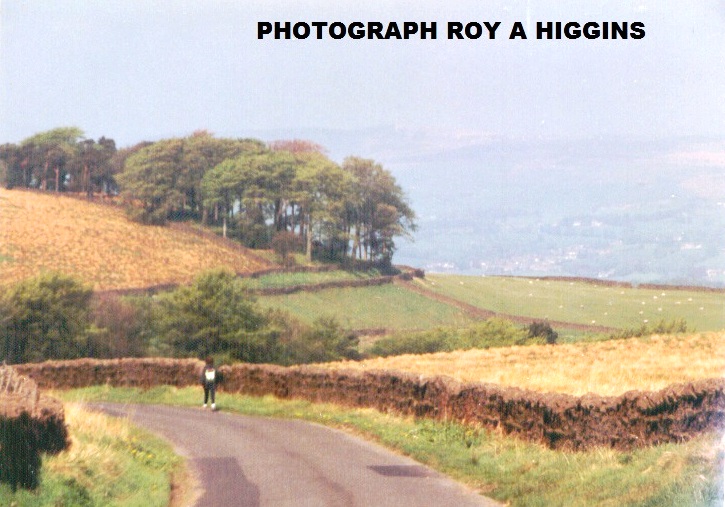
You may have realised by now that we are not in the Ribble Valley at all, but in the neighbouring district of Pendle. The road from Newchurch, which is situated at the foot of Pendle Hill, travels over the hill until it arrives in Downham village, which also sits at the foot of Pendle Hill on the other side in my home district of the Ribble Valley. You may  be able to make out the village of Downham in the valley below, it looks a long way off, but at least it's all downhill. On sunny days, some rather more daring people than I, para-glide from the top of the hill and float on the thermals.
   Pendle Hill dominates both the Pendle and Ribble Valley landscapes, and is regarded by locals with affection. Listen to the folk song 'Old Pendle' recorded by the Pendle Folk. 
At this time of the year the summer flowers are beginning to come to an end, and it's all about the berries. The one you probably know the best is the blackberry. There is nothing quite like home made blackberry pie, or even better apple and blackberry with custard. When we were kids we would spend whole afternoons, with a Tupperware box, collecting blackberries, but no matter how long we spent collecting them the container never seemed to fill. Perhaps that's because we ate more than we collected, grubs and all.

Rose hips are the fruits of the dog rose, and can be used to make Rose hip syrup, jam, herbal tea, wine, and as it's high in vitamin C, vitamin C supplements.


Sloe's are the fruit of the blackthorn and can be used to make sloe gin, brandy, jam or chutney.


Hawthorn berries are winter food for the Blackbird and thrush species of birds. Redwing's and Fieldfare's visit us from Scandinavia to feast on our winter supply of berries. They are also used to treat high blood pressure and angina.


Elderberry wine, or Sambucus, is a favourite, and elderberries are reputed to ward off the winter flue and alleviate allergies.


We have arrived in Downham, our destination, the church, can be seen at the top of the hill.
 Richard Assheton, my 11th great uncle, bought the village of Downham from Ralph Greenacres in 1558, and bequeathed it, along with the village of Whalley, to his nephew Ralph, my 10th great grandfather, on his demise in 1579. The Assheton family still own the village of Downham to this day.
  The village was used in the filming of the 1961 film Whistle Down the Wind, with Hayley Mills and Alan Bates, and the BBC television series Born and Bred, starring James Bolam, Richard Wilson, Clive Swift, Nigel Havers and John Henshaw, was filmed there. The building that you can see on the right was used as the doctors surgery and cottage hospital.


 St Leonard's church, our destination. Around the back of the church, and out of sight, where you would least expect to find it, is  the  tomb dedicated to members of the Assheton family.
 The Assheton Arms, which was named, I think, the Railwayman's Arms, or sum such, in the television series, even though there isn't a railway line to be found for miles, let alone a railway station,  is situated directly across the road from the church, and that, as you might expect, is our final destination.